
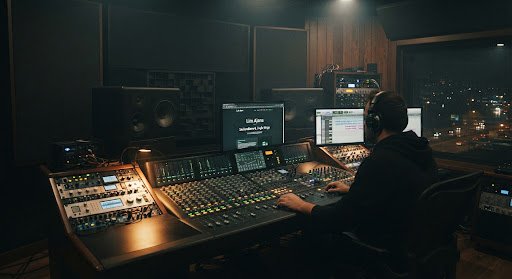
How can you achieve professional studio quality in your podcast recordings? Bringing your content up to broadcast standards with practical steps for equipment selection and audio editing is one of the most essential requirements for increasing listener retention and the perceived value of your content. The technical steps required for high-quality podcast production are:
1. Acoustic Isolation and Space Selection
The first step toward studio-quality sound is the recording environment. Empty rooms with hard surfaces and high reflection time (reverb) create echo and ringing in the sound. For recording, spaces with soft and irregular surfaces such as carpets, curtains, or bookshelves should be preferred; when possible, the room should be treated with acoustic foam or panels.
2. Microphone Type and Proper Use
In podcast broadcasting, microphone selection should be made directly according to the acoustics of the environment. In untreated or home recording environments, dynamic microphones that capture close sound and reduce background noise, such as the Shure SM7B or PodMic, should be preferred. In treated spaces, condenser microphones that capture a more detailed frequency range can be used. Microphone distance (10–15 cm) should be maintained, and a pop filter should be used for plosive consonants (p, t, k).
3. Signal Chain and Audio Interface (Preamp) Quality
For an intelligible recording, audio interfaces and preamps with a low noise floor are critical. Quality hardware that does not introduce background noise during digital signal conversion makes processing easier in post-production while preserving the naturalness of the voice.
4. Audio Editing and Digital Processing (DAW)
In the post-recording stage (inside DAW software), noise reduction, removal of unnecessary frequencies (EQ), level balancing (compression), and limiting of peak bursts should be applied in sequence. A balanced frequency range that does not tire the human ear should be created while preserving speech dynamics.
5. Loudness (LUFS) Adjustment for Broadcast Standards
Podcast platforms such as Spotify and Apple Podcasts require specific loudness standards. Bringing the content to -16 LUFS for stereo format (or -19 LUFS for mono) before publication ensures that listeners experience a consistent volume level across different devices and environments.
Conclusion: Professional audio quality in podcast broadcasting is achieved through the combination of proper acoustic space design, microphone selection suitable for the environment, and mixing/mastering processes adapted to standards. This technical discipline directly determines the sustainable success of a show.